
Always looking for a better way: meet Richard Lee, DNK's CTO
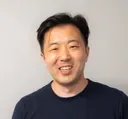
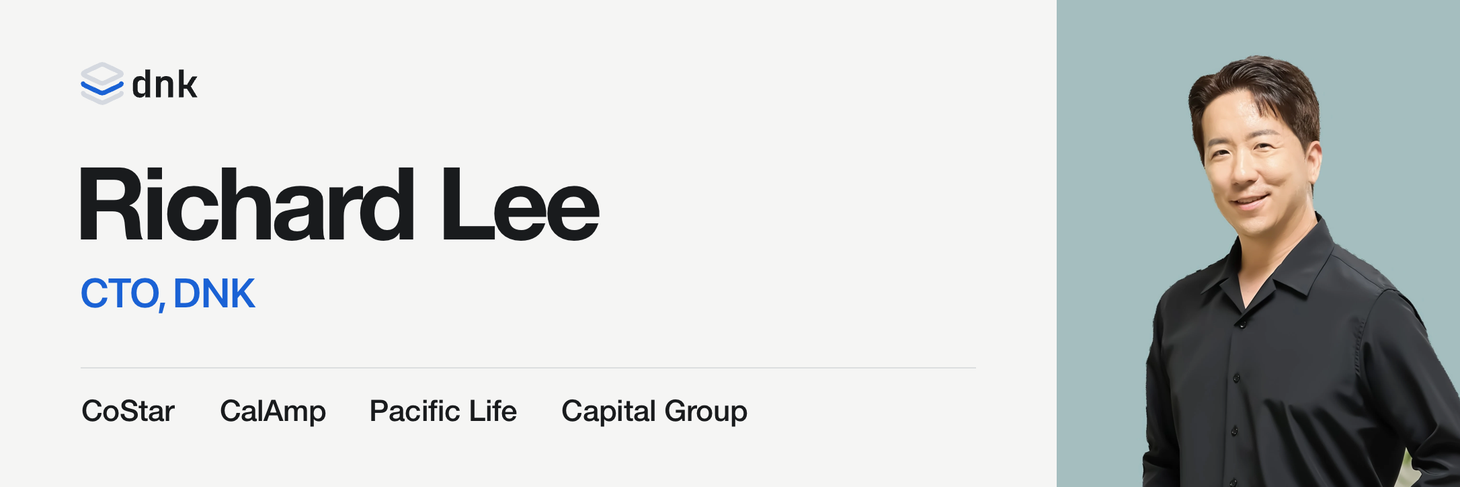
I would like to tell you about Richard Lee.
In some ways, Richard and I are a lot alike. We are the same age (around a month apart), both studied computer science in college, and ended up moving to Korea much later in life. How we both ended up in Korea and eventually at DNK, however, is very different.
I will do my best to share about Richard and his journey below, though if you ever get the opportunity to meet him, I would highly recommend you do it. He is one of those people you come across every once in a while that comes equipped with infinite great anecdotes that are littered with funny analogies.
Foreshadowing
Richard did not have any connection to the real estate field while growing up. His parents, immigrants from Korea to the U.S., settled in southern California. As Richard tells it, similar to other Asian American parents, his parents wanted him to pursue a career in medicine or law. He actually started down the medical path, but changed directions in college to computer science.
In college, Richard and a few friends had an idea for a real estate business. They wanted to put a computer screen in a real estate agent’s car so that, as someone drove through a neighborhood, they could look up information about the houses they passed.
I could hear a hint of regret in Richard’s voice as he told me the story.
He remembers having the idea for Redfin before Redfin existed. He and his friends never built it, and to this day still wishes they had. I asked if he had always been interested in real estate. He said no. What interested him at the time, he told me, was the idea that a small group of people with limited resources could build a business together. Told in retrospect, I cannot help but see this story from over 20 years ago as foreshadowing to his eventual life in real estate first at CoStar and now at DNK.
Today, Richard and I are working together on a different problem in real estate. He joined DNK in February 2025 as Director of Engineering and became our CTO in November.
A career spent learning
When Richard interviewed at CoStar, his future boss noticed that he rarely stayed at a company for more than a year or two. His answer was that he is a person that is always looking for a new challenge and a better way to do things. That way of thinking, coupled with those moves took him around into different industries as technology was quickly changing around him.
After graduation, Richard landed his first job at First American where he helped build an application that allowed banks and lenders to order services like title insurance and flood information online. Until then, someone had to pick up the phone to arrange them. A simple, but annoying problem solved.
For the next ten years, Richard went where the challenges and opportunities called him.
First, he made his way over to a company called Experian, where he helped integrate a consumer credit product into a larger company’s systems. Then an opportunity opened up at Capital Group, where he worked for about a year and a half on controls around how software was reviewed and released. After another two-year stint at Experian, he returned to Capital Group to help coordinate a data center move involving hundreds of interconnected applications.
The continual change of work kept things interesting, as Richard enjoyed the chance to learn new skills and grow as an individual. It was at his second rotation at Experian that he was introduced to the world of management.
Before joining CoStar, Richard worked at Kelley Blue Book, Pacific Life, and CalAmp. He spent about two years at each, taking on different roles and responsibilities. It was during these years that Richard honed knowledge and abilities in DevOps, cloud infrastructure, and AWS. CalAmp was particularly different, as it was a smaller technology company that required him to learn how to figure out how to get things done with limited resources.
In 2019, Richard made his way to CoStar where he worked on the infrastructure behind Apartments.com and LoopNet. CoStar was expanding Apartments.com so landlords could list properties and renters could go through more of the rental process in one place. Richard joined as a senior engineer and moved into management about a year later. At one point, his team was down to him and one other engineer. By the time he left, he had helped grow it to about sixteen people.
Richard credits one of his early managers at First American with helping shape how he leads people. He describes himself as a player-coach. To him, this is someone who gets into the details, shows people how he approaches a problem, and helps them develop the ability to do it themselves. I admire how he makes an effort to keep in touch with people he coached earlier in his career, some of whom are now senior directors and VPs.
Five years later when his time at CoStar came to an end, Richard decided to take a year off to travel. He spent about half of it overseas and the other half driving across the United States. Before he reached out to DNK, he had already decided to move to Korea.
When I asked him why, he answered without hesitation. He wanted to “try something impossible and new.”
He had spent most of his life and career in Southern California. He wanted to challenge himself and see how much of what he had learned would carry over to a different country. Having moved to Seoul myself, I can relate to that feeling.
A different way of building
2026 has been a year of tremendous change in our industry, as AI has forced everyone to rethink how work gets done. I decided to ask Richard how much he thought he had changed as a person over this past year. He said he was “more or less the same person.” I pushed him on that a little.
A year ago, much of his time was spent managing a team that wrote and tested its code by hand. This year, I watched him become completely engrossed in AI, build incredibly innovative ways to automate almost all of that work, and take responsibility for more of our products, from the screens customers use to the systems behind them. He even built a marketing agent to help with work outside engineering.
Richard saw a connection to the way he had always worked. Years earlier at Kelley Blue Book, he had automated enough of his work that he could release software and monitor it from his phone. He had already lived through the move from early websites to cloud infrastructure. What felt different about AI was the pace and the scale of what a small team could now do.
Richard believes AI gives a small team opportunities that once required more time, money, and people. I have seen that firsthand at DNK. We went through a bit of a reckoning ourselves this year. We had to reconsider how we build and test software, what we can take on as a team, and what our products can eventually do for customers. Richard has been central to those conversations and the work that followed. He is consistently ahead of the curve, learning new technologies himself, showing the team what he has learned, and continually improving them while keeping us all in the loop.
His experience in financial services matters here, too. As we find faster ways to build, we still have to check the data, protect it, and give customers a platform they can rely on. Richard knows how much care goes into running systems that people depend on.
Building for Japanese real estate
Every month, investment and asset managers in Japan receive property management reports from different property managers, often in Excel files with different layouts and terminology. Before a team can compare buildings or understand a portfolio, someone has to find the right figures and make them consistent.
We recently released Data Manager to help with that work. Richard led the development of Hephaestus, our proprietary ingestion engine, which extracts, checks, and standardizes the information in those reports. Our team has now worked through more than 3,000 reporting variations. The knowledge gained from those reports helps us handle new ones, including the exceptions that make this work so difficult.
This is also why Richard’s experience is so valuable alongside Takashi “Tak” Naito, our Japan CEO and DNK’s COO. Tak has spent more than 25 years in Japanese real estate investment and banking, including leading DWS’s real estate business in Japan. He knows what customers need to understand when they are evaluating an investment or managing a building.
Within his first few weeks at DNK, Tak wrote a note to our product team explaining details like why rent and common-area maintenance charges need to be recorded separately. A difference that looks small on a spreadsheet can change how someone interprets a building’s performance. Richard and the engineering team have to turn that kind of knowledge into a system that can handle those differences consistently, month after month.
Together, they bring experience making real estate investment decisions and building the technology people use to make them.
Where we go from here
Richard is now approaching two years at DNK. For much of his career, that was about the time he would be looking for his next challenge. He has told me that he is committed to seeing what we are building here through to the end, and that means a great deal to me.
I believe this is the most exciting time in history to be working in technology. AI is changing what a small team can build, how quickly it can learn, and what people can do with information. There is no way for us to know exactly what the tools will look like a year from now, but we can keep exploring what they make possible and using what we learn to make great products.
For our customers in Japanese real estate, I believe that creates an enormous opportunity. Our vision is to become the system of record for the operational data of every real estate asset in Japan. As we organize and secure that information over time, a building’s history can remain useful when teams change and properties change hands. I want customers to be able to look across years of data, understand what is happening in a building or portfolio, and put that information to work in Excel and, increasingly, with AI.
When we released Data Manager, Richard wrote that it was the platform he was proudest of building and the one he would want to use if he were in our customers’ seat. That meant a lot to me. I see every day how much he and our team put into getting us here, and I consider myself extremely lucky to be surrounded by such talented and committed people.
I keep thinking about that question Richard had in college, of what a small group of people could build with limited resources. More than twenty years later, he is helping us answer a version of it at DNK, granted with a lot more experience behind him and a whole new set of tools to work with.
I am grateful he chose to bring that experience to our team, thankful to have him as a partner and friend, and could not be more excited to see what we build together at DNK.

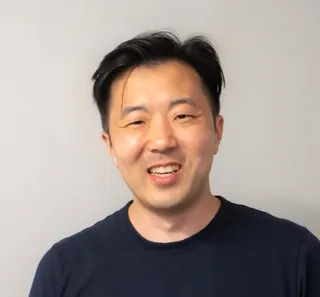
Matthew Shampine - Co-founder & CEO of DNK Newsletter
Join the newsletter to receive the latest updates in your inbox.