
Why I Asked Tak Naito to Lead DNK Japan

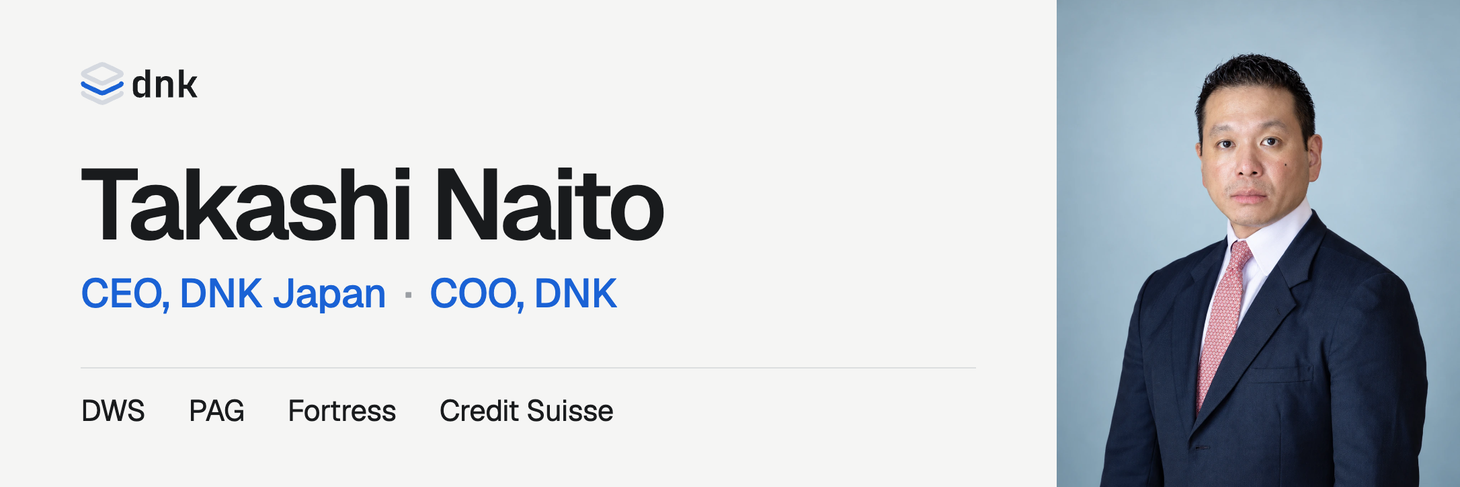
A little over two years ago, my close friend and DNK angel investor, Josh Schwab, introduced me to Takashi “Tak” Naito. Josh and Tak had worked together at Credit Suisse “back in the day.” At the time, Josh knew I was looking for someone to run our Japan office and thought Tak might know someone who could be a good fit.
I remember taking our first call from the lobby of the GranTokyo building next to Tokyo Station, the same building where the DNK Japan office is today. During that conversation, Tak told me about an idea he’d had for a digital platform while working at a previous firm.
What he described sounded a lot like what our team was already working on for the Japanese market. Tak had seen the need firsthand as an industry veteran, and we were building technology to address it. The more we talked, the more it felt like a natural fit.
What started as an introduction to help me find someone to lead Japan became a conversation about whether Tak might be the right person to take on the role himself. In October 2024, he joined us as CEO of DNK Japan. Today, he also serves as COO of DNK.
Tak’s experience
Tak has more than 25 years of experience in real estate investment and banking. Before DNK, he led DWS’s real estate platform in Japan and its alternatives investment department (DWS is a German asset management company that previously operated as part of Deutsche Bank). Earlier in his career, he was a managing director at PAG, where he helped build real estate and distressed debt investment businesses, an early member of Fortress Investment Group’s real estate business in Japan, and a director in Credit Suisse’s real estate private equity business.
Those roles gave Tak experience across the same work many of our customers do: sourcing and evaluating investments, managing assets, and working with the information needed to understand how properties are performing to maximize returns. In other words, he knows what it takes to move from a stack of reports to a decision.
One of the things that I’ve really come to appreciate about Tak is how much attention he gives to the details behind that information.
Within his first few weeks at DNK, Tak put together a detailed note for our product team on what investment managers need from property data. He started from the basics such as rent per tsubo, a common measure of rent by floor area in Japan and also covered why rent and common-area maintenance charges should be recorded separately, along with occupancy and the differences between Japanese lease types and moved to more complex tax and structural concepts as discussions progressed.
All of these details shape how data needs to be recorded and how a team interprets a property’s performance. They also help us ask better questions when we’re deciding what to build and in turn, build a superior product.
Turning property reports into useful data
That perspective is especially valuable for the work we’re doing today. Every month, investment and asset managers receive property management reports (PMRs) from different property managers, often as large Excel files in varying formats. Before teams can analyze the information across a portfolio, they have to find the reports, pull out the numbers, and make them comparable.
We recently made Data Manager publicly available to help with that process. It brings PMRs together and gives teams access to the information inside them.
Hephaestus, our proprietary ingestion engine, is the special sauce that helps make that data useful. It combines Japanese real estate expertise, extraction logic, validation rules, and technology to extract, check, and standardize data from reports. Our team has now processed thousands of PMRs across more than 3,000 reporting variations.
Working across those variations is difficult. A change in a label or layout can make a figure easy to misinterpret, and an error can carry through to an investment decision. Making the data consistent and useful takes engineering and a deep understanding of Japanese real estate.
With standardized data, teams can bring the information into the Excel workbooks and models they already use, spending less time preparing it themselves. Over time, this foundation can not only support more of the day-to-day work of managing real estate, but provide invaluable insights into the data itself while also allowing decisions to be made faster and more confidently. Better data can help investment managers identify opportunities to create alpha.
Tak’s experience helps us think through what that work needs to look like in practice, which data investment managers rely on, how Japanese reporting and lease conventions affect it, and how to make the information useful in the workflows people already have.
Building for Japan
Our commitment to Japan is local and long term. Our team in Tokyo works alongside our team in Seoul, with Tak leading in Japan and across DNK as COO. Building here means understanding the language, culture, reporting practices, and relationships of our customers. It also means listening to the people who use our products.
Over the past two years, Tak has helped us build the team, work with customers, and bring real estate experience directly into product and engineering decisions. His perspective has a central role in how we build and operate.
Our vision is to become the system of record for the operational data of every real estate asset in Japan. That means ingesting, standardizing, and securing PMRs so a property’s history can remain useful as teams change and assets change hands. As AI tools become more widely available, I believe the data in each company’s own reports will become increasingly valuable. It needs to be organized, secure, and usable.
Over time, I hope that gives investment managers, asset managers, property managers, brokers, and others across the industry a stronger foundation for working together and making decisions.
When someone shares their property reports with DNK, I want them to know the people on the other side understand the information in those files and the decisions that depend on it. Tak is a big part of the team I trust to help us do that.
I’m grateful that Josh made the introduction, and that Tak decided to join us. Looking back, taking that first call in the building that would become home to our Japan office feels like one of those moments that was meant to be. I’m excited to keep building DNK with Tak and our teams in Tokyo and Seoul.


Matthew Shampine - Founder & CEO of DNK Newsletter
Join the newsletter to receive the latest updates in your inbox.